Showing posts with label piping. Show all posts

Friday, March 28, 2008

Raw silk suit almost finished

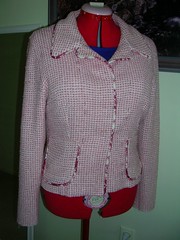
Almost there! This is the point where I start thinking about the next project and if I didn't have my Rule, I'd end up with UFOs all over the place.
raw silk suit, nearing the finish
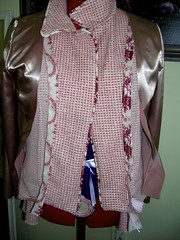
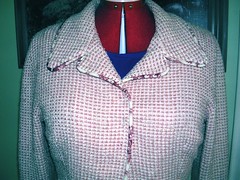
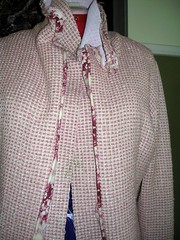
Here, I've pinned the jacket shut to simulate buttons. Everything is done except for the sleeve hems. Peter thought I might want to put seam binding along the bottoms of the sleeves and I plan to pin some there to see what it looks like. He may be right. You might notice that I have put a row of pins down the fronts, to hold the fabric up and keep it from buckling at the bottom edge. I may take a few loose stitches in the shoulders to prevent this from happening in the finished jacket.
raw silk suit, nearing the finish
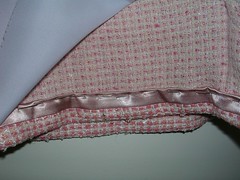
The skirt is complete. I decided to cut a few pieces of bias from the satin and finish the skirt hem in it. I sewed the satin on by machine to the raw edge of the hem and then I folded the other raw edge under and hand sewed the hem to the skirt. And no one will ever see this.
raw silk suit, nearing the finish
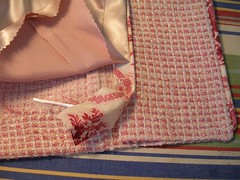
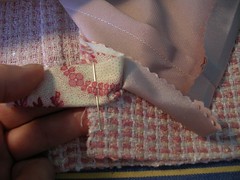
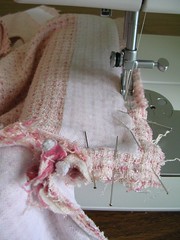
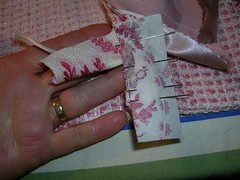
Back to finishing the inside of the hem on the jacket. Before I could sew down the lining to the hem, I wanted to finish that tiny bit of raw fabric at the bottom edge of the facing. The Threads magazine suggests putting a bit of bias tape on it and in this photo, I have pinned the tape to the edge. I sewed it to the edge by machine before folding it over to encase the raw edge of the facing. By machine sewing, I also was able to catch the end of the piping cord in the stitching, thus anchoring it even more than I had already.
raw silk suit, nearing the finish
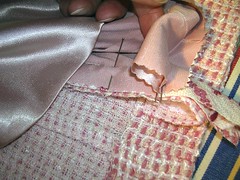
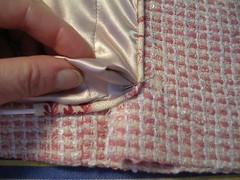
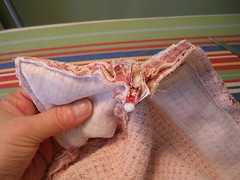
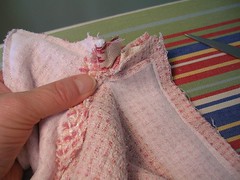
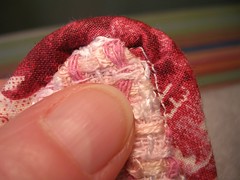
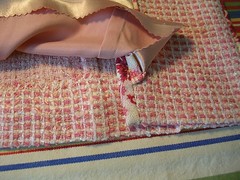
Then I folded the tape around the edge of the facing and tucked the end under and sewed it down by hand. You might want to make this photo larger to see the detail. For someone who is picky about finishing the insides of her garments, even this may be a bit much for me for future jackets. The piping is nice but I wonder if it's worth it, especially with the fuss at the bottom because f the fold in the lining for ease. If I do this again, I may have to eliminate that fold. But I like the bit of bias over the raw edge.
raw silk suit, nearing the finish
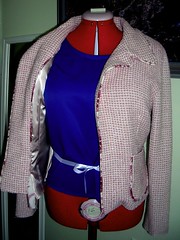
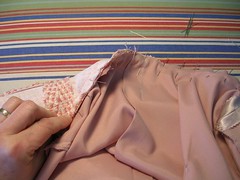
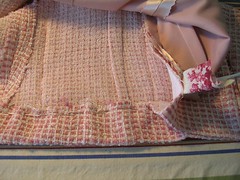
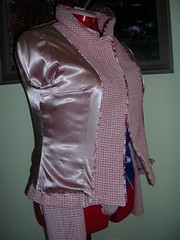
Here is the jacket on Rose, inside-out. The lining hem is pinned up to the jacket hem. I suppose it looks a little more relaxed, now that I've sewed it but I'm not convinced the piping is worth the trouble.
raw silk suit, nearing the finish
I think the jacket does need more of the piping fabric as an accent on the exterior. That's why I'm going to test it around the bottom edge of the sleeves when I hem them, and that's why I'm going to use it on the buttonholes. I can't use my automatic buttonholer anyway, because of the thick piping at the front edge of the jacket. So I'm going to do some machine zigzaging to make the fabric sturdy and then do a bound buttonhole with the floral fabric. And then I am going to make fairly large covered buttons using the floral fabric to cover them! I can't imagine this jacket with any other buttons - plastic, pink, gold or whatever. I think they have to be covered in the floral. So that's next, after I make the trek to Fabricland for the button forms.

Saturday, March 22, 2008

Piping between the facing and the lining

Happy Easter all. It is nothing like Spring out there right now, at -11C or 13F. Brr! The sun is nice and bright, so at least there's that.
piping the silk jacket
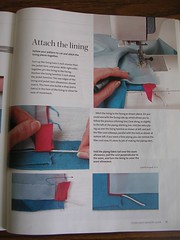
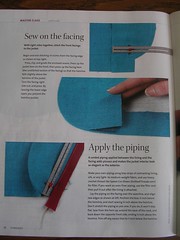
To put piping between the facing and the lining, I am using instructions from the March 2006 Number 123 issue of Threads Magazine (pages 77-80). You can go to www.threadsmagazine.com and look for specific issues but instead of giving you the article, they ask you to buy that issue. As it turns out, it's not too complicated but I had to make modifications and there was some confusion until I actually was turning the fabric in my hands. But I wouldn't have had the idea to do this if it weren't for Threads Magazine.
piping the silk jacket
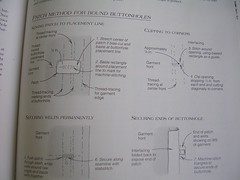
I'm putting these photos here so you can get the idea about how the magazine did the tutorial but you can't read what is written there so I don't think I'm violating copyright.
piping the lining
Here's what the jacket looks like at the moment. All the pieces are now together and I have even put the pockets on. I haven't quite finished the internal piping at the bottom but that's because I haven't sewed the hem which has to be done first.
piping the lining
Back to the beginning. First I had to attach the piping to the raw edge of the facing. That was pretty straightforward and I left a fair bit (about 2 inches from near the top of the jacket hem) at the bottom in case I needed it. I am also using a thinner cord for the piping. It is about a third of the thickness of the exterior piping cord.
piping the lining
The article suggests leaving the facing free at the bottom by a couple of inches and I have done that. And don't forget that you are only going to sew the piping to the lining and so you will keep the hems free.
piping the lining
Once I had the piping sewn on to the facing, I draped the jacket over Rose and draped the lining over it too. The lining in the photo just confuses things, sorry. But what I find interesting was how different the piping is, depending on what diagonal I cut it on. In the photo, the right side is dark pink and the left side is totally pale. There is a bit of this unevenness of colour around the collar - one side is slightly darker than the other - but I am glad that this amount of contrast is now on the inside of the jacket. I think I planned it that way. :)
piping the lining
Once the piping was on, I pinned and then sewed the lining to the facing. I had already assembled the lining with the sleeves and everything so it was just a matter of sewing it to the facing which was pretty straightforward.
piping the lining
I didn't sew the lining all the way to the bottom of the hem. In a regular lining, you are supposed to leave the bottom 6 inches free and sew it down later by hand. This is where the modifications and some confusion came in. In the Threads model, there does not appear to be that extra fold of fabric in the lining at the bottom. Because I had not modified my pattern, I still had the fold of fabric (for ease) that most lined jackets have and now I had to figure out what to do with it.
piping the lining
I fiddled around with keeping the fold free and sewing down to where I would be hand stitching the lining to the jacket but then I caught the very bottom of the lining in the machine stitching and realized that it wouldn't work that way and had to rip it out.
piping the lining
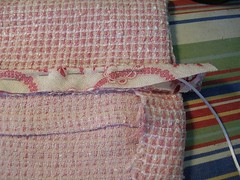
I left the lining sewed down to very near where the lining hem will be, but not to the very bottom. Then, I bent the piping off to the side, along the line of where I will be hand sewing and machine stitched it into place. I like the sturdiness of machine stitching, especially on loosely woven fabrics, and I wanted to also make sure the piping cord was well anchored by stitching.
piping the lining
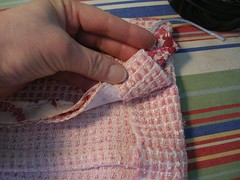
Here, I've pinned the lining to where I will be sewing it and you can see how the fold will work now (at least, I can). This is where I realized that I cannot finish it yet until I have sewing the jacket hem, which has to be done by hand.
piping the lining
So the bottom edge of the piping is on hold while I finish the jacket hem. And then I will also show what the Threads magazine suggested for the tiny raw edge of the hem. Assuming it all falls into place!

Tuesday, March 18, 2008

Piping the silk jacket

So cute, so far!
piping the silk jacket
When I sewed (basted) the piping to the jacket, I used a slightly contrasty pink thread in the bobbin so that I might be able to see it and follow that line when I sewed the facing to the jacket. It worked here and there but blended in too much with the fabric to be really useful.
piping the silk jacket
In the end, it didn't really matter because I could following the fat piping cord pretty well with the zipper foot except for one collar corner that I had to unstitch and re-sew. In this shot, I am sewing up the front toward the lapel corner. You might also notice that I have ironed on a but of interfacing to the jacket front (in addition to the facings which is normal). I am anticipating buttonhole issues.
piping the silk jacket
First of all, it looks like a jolly mess at the inside corners, where the lapels meet the collar.
piping the silk jacket
And it IS a mess - you sort of have to feel your way like Yoda. You have to trim some of the excess fabric and piping cord but not TOO much, otherwise the ends will pull out. And don't sew too far into the corners because you could catch more fabric than you want. Better to sew less and then stitch it up by hand when it is turned right-side out.
piping the silk jacket
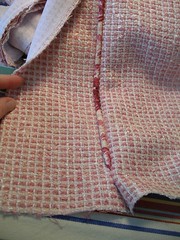
Here's what the piping looks like down the front. It is turned into the seam allowance 1 and 1/2 inch above the bottom because that is where the hem will be.
piping the silk jacket
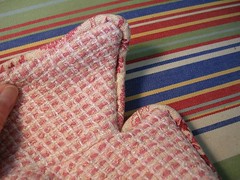
Here's one collar corner turned right side out but not yet pressed. Looks okay but...
piping the silk jacket
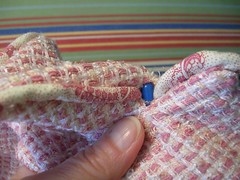
When you poke around in there, it is clear that there is a big gap where I didn't machine sew too closely into the inside corner. That's the blue handle on my seam ripper, showing through the gap.
piping the silk jacket
Also, at quite a few places along the piping, you can see some of the basting stitches because I didn't press closely enough to the piping cord as I sewed the true seam. I think I am going to sew by machine, a topstitching type of line down the piping to flatten the fabric and to compensate for missing some of these basting stitches.

Monday, March 17, 2008

Continuing with the Chanel suit

Boy time flies when you're doing other things! I have been working on the suit but haven't been blogging. I am taking a course which is now over except for the exam which will be on March 30. The course was every Sunday, all day, for four Sundays. It was about how to be a personal trainer - not sewing related. You can check it out here. Anyway, back to the suit.
silk suit
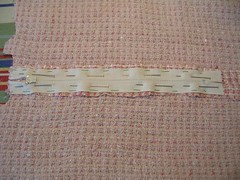
I can always tell when I am making progress when the various pieces of fabric suddenly get sewed together and they are not all over my sewing room. I have almost finished the skirt. It is the pattern I make over and over so I can do it in my sleep. Here, I am just showing the zipper, how I pin it on and then baste it.
silk suit
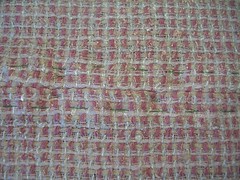
Especially with loose fabric like this, you want to be careful that the fabric doesn't get rucked up one side and down the other when you sew in the zipper. Because the "stripes" are so close together and because they aren't uniform anyway, I am more concerned with making sure the vertical threads line up than the horizontal. I take the pins out before I sew with the machine, of course.
silk suit
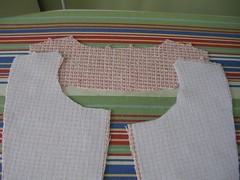
I sewed just the facings together and did not then attach the lining to the facings. I am going to be putting a thin line of piping between the facing and the lining and will do that after I attach the facings to the jacket. All will become clear soon!
silk suit
I've attached the sleeves to both the jacket and the lining and draped everything over the dummy. I have also basted the piping on to the front edges and around the collar of the jacket. In the photo, I've tried to tuck the raw edge of some of the piping under, so you get a glimpse of what it will look like.
silk suit
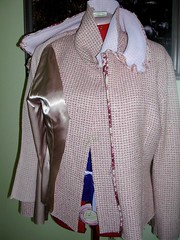
Here, I've pulled back the jacket to show the lining and the facings draped over the dummy. That sure is shiny smooth satin! I will be making a blouse out of it but later. Next, I will sew the facings to the jacket and sandwich the piping between them into its finished position.

Tuesday, March 11, 2008

Pockets on the raw silk

Pockets! I had forgotten about pockets until I was looking at the photo of the real Chanel jacket and saw them there. So I went and cut out pockets.
pockets on the raw silk
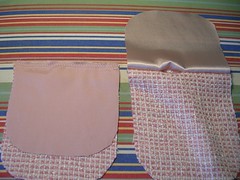
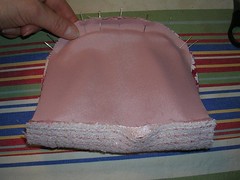
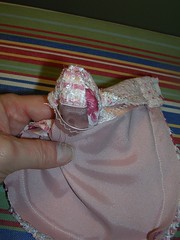
I used a template from another pattern and decided to line the pockets and pipe the edges. I'm using the satin for the lining, not the other stuff I'm using for the skirt. I have left a small gap where the lining is sewn to the pocket to facilitate turn it right side out when it's time.
pockets on the raw silk
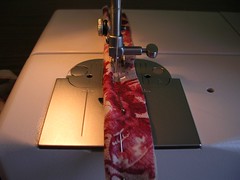
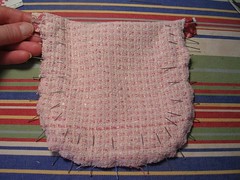
I had to make some piping for around the edges of the pockets. Just sew down the cord wrapped up in the bias tape.
pockets on the raw silk
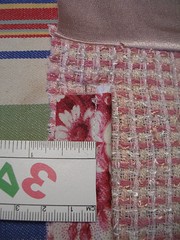
The seam allowances are a tiny bit more than the 5/8 usually used because of the width of the bias tape. I'm not concerned by this little discrepancy. I could always trim it but I think I'll just eyeball it instead.
pockets on the raw silk
I have to visualize how the cord will disappear into the pocket (into the seam allowance) once it is turned right side out.
pockets on the raw silk
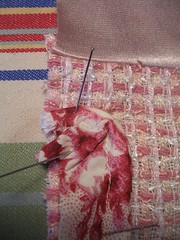
First, I machine basted the piping to the pocket to fix it in place. Then I pulled the lining down to the pocket seam allowance and pinned it together, putting the pins in from the pocket, not the lining side.
pockets on the raw silk
Once I had wiggled the ends of the piping out to where they would be sewn into the seam, I sewed the pocket to the lining form the pocket side because I could use the line of basting I had already put on the fabric as a guide. I sewed slightly inside the basting to make sure the piping was not too loose.
pockets on the raw silk
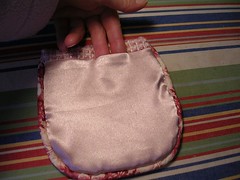
I started to turn the pocket before I realized I had to trim the seam allowance. So I started over, trimmed the excess fabric and then turn the pocket through the little gap I had left.
pockets on the raw silk
Here's the pocket, turned but unpressed and the gap is still not stitched up. I have been thinking about putting trim on the outside of the pocket, across the top as they do in many of the Chanel suits but I have decided against it, thinking it will be too busy for me. I think the contrast piping is enough. I am still not sure where to place the pockets on the jacket and will have to assemble it enough so I can put it on the dummy and then figure out the best placement.

Saturday, March 01, 2008

Piping for the raw silk

"I'm so excited!" I went shopping today for piping material and got so much more.
new patterns
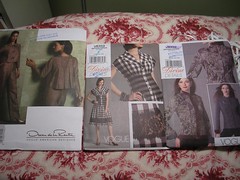
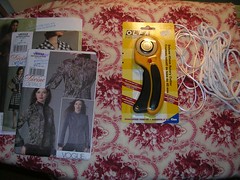
First of all, when I walked into the Fabricland, I saw that they had Vogue patterns on sale. I am still looking for the perfect jacket pattern (actually something more than that but that's another story) and I sat down and looked through the patterns. I ended up with three different patterns - one for a short, swingy jacket with back pleats, one for a reversible jacket that looked interesting and one for a dress that I had seen at A Dress A Day.
purchases
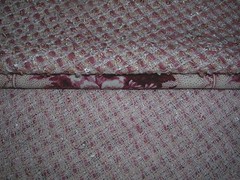
Then I went looking for that pink-and-white quilting cotton for the piping. I had it in my head that it would be just the two colours and a sufficiently large print that you couldn't tell what was going on once it was piping. But of course, once you start looking for something you imagine, it doesn't always appear. I was torn between a pink with a tiny yellow flower on it and some pink and white mottled stuff when the sales clerk told me there was some other stuff on sale. I went to look at it and there it was.
piping ideas
The best thing was that it didn't have a white background. I saw right away that the cream worked better with the silk which has quite a lot of yellow in it when you look at it closely.

In addition, I decided it was time I had a rotary cutting tool and a self-healing cutting mat and I got those too. I have two sized of piping cord because I'm going to use the smaller on the inside with the lining, as suggested by Threads magazine, which I will blog about as I do it.

Tuesday, February 26, 2008

A Chanel jacket

I've decided on the Chanel jacket for my next project. I'm going to use an old pattern I have made several times before but not recently.
a Chanel type jacket
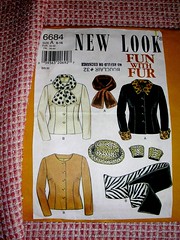
It is New Look 6684. I actually never made it with the faux fur accessories and I have never made it with the collar either. At the time, I wanted a short, boxy jacket and it worked well.
a Chanel type jacket
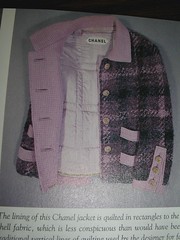
If you look at this Chanel jacket in my Couture sewing book, it looks like it could use this sort of pattern. I won't be using a contrasting fabric for the facing and collar but I will have to go hunting for the right trim. I am thinking piping for the edge of the collar and fronts and using the same piping fabric to trim pockets.
a Chanel type jacket
I am going to use the plainer raw silk I got as a Fabricland bargain. I have two pieces of the raw silk but just enough in the fancier one with the gold thread to make a jacket. In the pink, I have enough for a skirt too. There are all kinds of flaws in the fabric so I will have to be careful cutting. I am going to use a nice pale pink satin for the lining and I think I have enough of that to make a shell or tank type top, as Chanel did for her outfits.
a Chanel type jacket
Here's the jacket in a maple leaf tartan that I made more than 10 years ago. (Note the maple leaf buttons!)
a Chanel type jacket
Here's the back. You can see it has darts to give it a bit of shape and I think I will also incorporate them into the silk jacket, although I may decide against them as I start fitting it.
a Chanel type jacket
And here is the inside. One of my Threads Magazines has an article about putting a thin line of piping down where the lining is stitched to the facing and I may also add that detail to this jacket. So after I cut it out and ponder on it for a while, I will have to go looking for piping materials.